
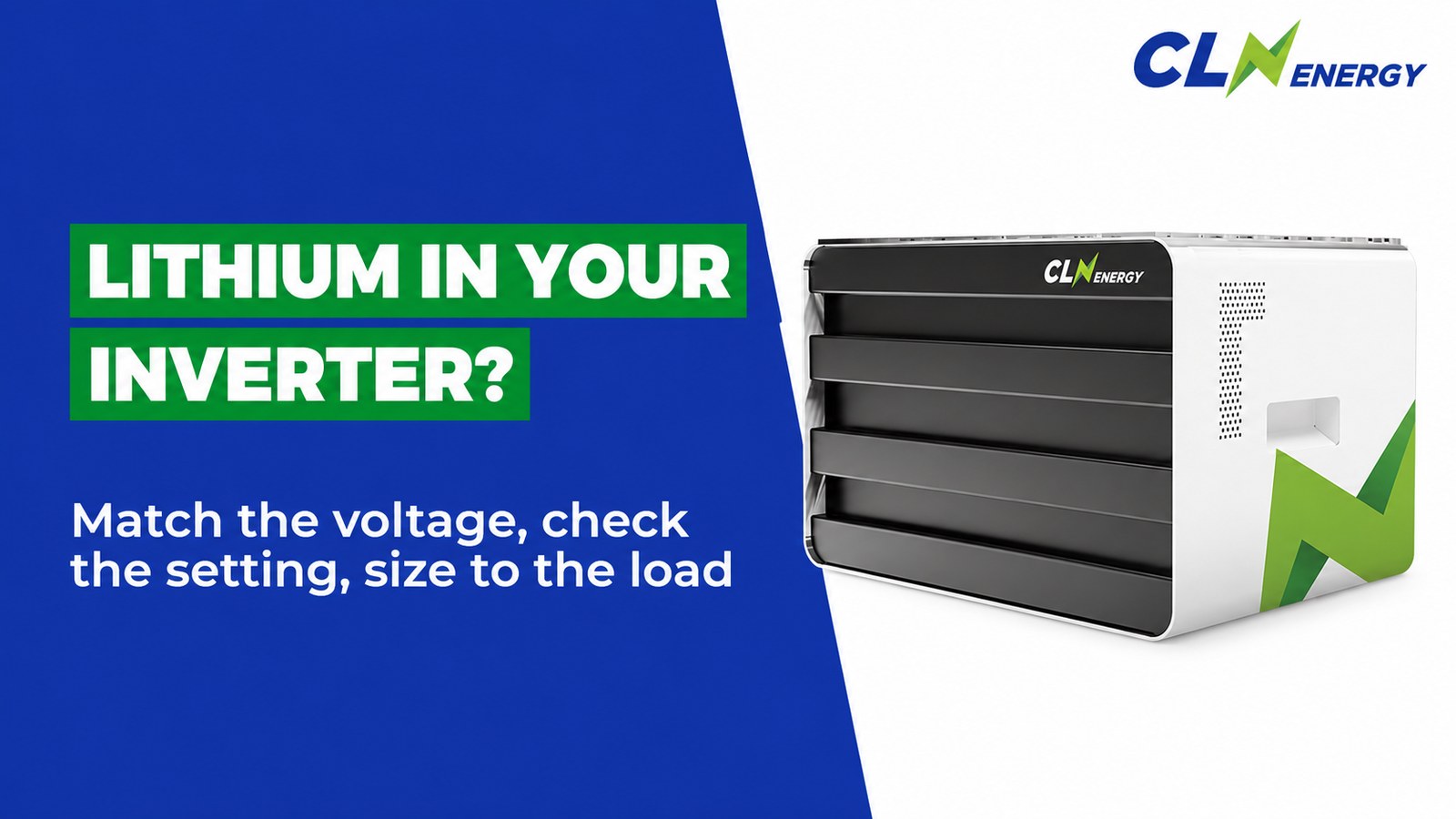
Usually, yes. Most normal home inverters in India — the one already on your wall — will run a lithium iron phosphate battery in place of a tubular one, provided three things line up: the battery's voltage matches the inverter, the inverter's charge setting suits lithium, and the battery is sized to the load you actually run during an outage. Get those three right and the inverter, the wiring and the corner of the room all stay as they are.
This guide takes the three in order, then covers what changes when the tubular battery goes, and the situations where the existing inverter genuinely will not do.
An inverter is built around a battery voltage — 12V, 24V or 48V — and the replacement has to match it. The lithium numbers read slightly higher, which confuses people: a lithium iron phosphate cell is 3.2V where a lead-acid cell is 2V, so four lithium cells make 12.8V, eight make 25.6V and sixteen make 51.2V. The pack is the lithium equivalent of the same system, not a different one.
| Your inverter | Tubular setup today | Lithium equivalent | CLN packs that fit |
|---|---|---|---|
| 12V | One 12V battery | 12.8V | Table Top 12.8V 100Ah |
| 24V | Two 12V batteries in series | 25.6V | Table Top 25.6V 100Ah, Wall Mounted 25.6V 200Ah, Ground Mounted 25.6V 230Ah and 314Ah |
| 48V | Four 12V batteries in series | 48V or 51.2V | Wall Mounted 51.2V 100Ah, Ground Mounted 51.2V 230Ah and 314Ah, Stackable 48V from 4.8 to 19.2 kWh |
The voltage is printed on the inverter's rating plate and in its manual. If the plate is gone, count the batteries: one 12V battery means a 12V inverter, two in series means 24V.
This is the step that decides whether you get the capacity you paid for. Most home inverters were installed with tubular batteries and charge to a lead-acid profile. A lithium pack on a lead-acid profile is rarely damaged — every CLN pack has a battery management system that protects it — but it often stops short of a full charge, so the battery quietly holds less than it could.
Look for a battery-type setting on the inverter: many models offer lead-acid, tubular, SMF and lithium. If yours has a lithium option, select it. If it lets you set the charging voltage and current directly, match them to the pack:
| Setting | Table Top 12.8V 100Ah | Table Top 25.6V 100Ah |
|---|---|---|
| Charging voltage | 14 V | 28 V |
| Maximum cut-off voltage | 14.4 V (±0.4) | 28.8 V (±0.8) |
| Minimum cut-off voltage | 10.0 V (±0.4) | 20.0 V (±0.8) |
| Recommended charging current | 30 A | 30 A |
| Maximum charging current | 50 A | 50 A |
If the inverter has no battery-type setting and a fixed lead-acid profile, do not guess. Send us the inverter's make and model and we will tell you whether it will charge the pack properly or whether one of the routes in the last section is the better answer.
The VA figure on the inverter tells you what it can drive. It says nothing about how long the battery will last — that comes from the load you keep running in an outage and the hours you want. Work it out in watts: add up what stays on, multiply by the hours, and you have the energy you need.
Four ceiling fans at 75 W, six LED lights at 10 W and a television at 100 W come to about 460 W. Four hours of that is roughly 1.8 kWh. A 12.8V 100Ah pack holds 1.28 kWh nominal, so that household wants either two of them or a 25.6V pack on a 24V inverter.
Here is the arithmetic for our residential packs — nominal energy divided by the load. An inverter loses some energy converting battery power to mains, so treat these as upper figures:
| Pack | Energy | At 300 W | At 500 W | At 800 W |
|---|---|---|---|---|
| Table Top 12.8V 100Ah | 1.28 kWh | 4.3 h | 2.6 h | 1.6 h |
| Table Top 25.6V 100Ah | 2.56 kWh | 8.5 h | 5.1 h | 3.2 h |
| Wall Mounted 25.6V 200Ah | 5.12 kWh | 17.1 h | 10.2 h | 6.4 h |
| Ground Mounted 25.6V 314Ah | 8 kWh | 26.7 h | 16 h | 10 h |
| Ground Mounted 51.2V 314Ah | 16 kWh | 53 h | 32 h | 20 h |
The battery also has to deliver the current the load draws. A Table Top 12.8V 100Ah pack is rated for 50 A recommended and 100 A maximum discharge — about 640 W continuous and 1,280 W at peak. The 25.6V pack doubles both. If a mixer, an iron or a pump is on the inverter, check its wattage against those figures, not just the hours.
| Lithium iron phosphate pack | Tubular lead-acid battery | |
|---|---|---|
| Topping up | Never — sealed | Distilled water, checked regularly |
| Gas while charging | None | Releases gas, needs ventilation |
| Space and weight | Table Top 12.8V 100Ah: 17 kg, 330 × 255 × 180 mm | Heavier and larger for the same backup |
| Voltage through the outage | Holds steady until nearly empty | Sags as it discharges |
| How deep it can be used | Rated at 95% depth of discharge | Conventionally used to about half |
| Rated cycle life | 3,000 (Table Top) or 6,000 (Wall and Ground Mounted), both at 95% DOD | Your own replacement record |
| Warranty | 5 years across the residential range | As per your current battery |
| Working temperature | 0 to 60°C (Table Top) | Life shortens as heat rises |
The number worth comparing is not the price of one battery against another. It is how many batteries you buy over the same years, and most households already know how often the tubular battery has been replaced.
Sometimes the honest answer is that the inverter is the limit, not the battery. That happens when the inverter has a fixed lead-acid charge profile it cannot change, when its charger current is far below what the pack needs to recharge between outages, or when you want solar and the inverter has no solar input. Two routes work:
| All-in-One model | Power rating | Battery energy | Solar input |
|---|---|---|---|
| Wall Mount 900VA / 12.8V | 900 VA | 1,280 Wh | 1 kW |
| Wall Mount 1100VA / 12.8V | 1,100 VA | 1,280 Wh | 1 kW |
| Wall Mount 1600VA / 25.6V | 1,600 VA | 2,560 Wh | 2 kW |
| Wall Mount 2000VA / 25.6V | 2,000 VA | 2,560 Wh | 2 kW |
| Table Top 2000VA / 25.6V | 2,000 VA | 2,560 Wh | 2.2 kW |
| Table Top 3000VA / 25.6V | 3,000 VA | 2,560 Wh | 3 kW |
| Stackable 5 kW / 51.2V | 5 kW | 10, 15 or 20 kWh | — |
All carry a five-year warranty. If solar is on your list anyway, the solar lithium battery page sets out on-grid, hybrid and off-grid side by side.
The residential packs, grouped by inverter voltage, are on the lithium battery for home inverter page. If you are replacing a lead-acid battery in something other than an inverter, lead-acid to lithium replacement covers the drop-in 12.8V and 25.6V packs.
For most homes, yes. A lithium iron phosphate battery can be used to a much deeper depth of discharge than a tubular battery, holds its voltage through an outage, needs no water, and is rated for thousands of cycles — 3,000 on our Table Top packs and 6,000 on our Wall and Ground Mounted packs, both at 95% depth of discharge. The two things to get right are the voltage match and the inverter's charge setting.
Yes, on the same terms as an inverter, because a home UPS in India is an inverter with a battery. Match the battery voltage — 12.8V for a 12V unit, 25.6V for 24V — set the battery type to lithium if the unit offers it, and size the pack on the load you keep running. A computer UPS with a small sealed battery built in is a different product and is not designed for a lithium replacement.
Usually not. The inverter needs to run at the same battery voltage and charge in a way that suits lithium. Many home inverters have a battery-type setting with a lithium option, and those work as they are. Only an inverter with a fixed lead-acid charge profile that cannot be changed is a real limit, and then an inverter with a lithium setting or an all-in-one unit is the better route.
It depends on the battery's voltage and discharge rating rather than the amp hours alone. A 12.8V 100Ah Table Top pack is rated for 50 A recommended and 100 A maximum discharge, which is about 640 W continuous and 1,280 W at peak — typical of an 850VA to 1kVA home inverter. A 25.6V 100Ah pack doubles both, which suits a 1.5kVA to 2kVA 24V inverter.
Divide the battery's energy by the load. A 12.8V 100Ah pack holds 1.28 kWh, so a 300 W load runs for up to about 4.3 hours and a 500 W load about 2.6 hours. The inverter loses some energy in conversion, so real backup is a little lower. Size on the load you actually keep running in an outage, not on the inverter's VA rating.
Cycle life is rated per model: our Table Top packs at 3,000 cycles and our Wall and Ground Mounted packs at 6,000, both at 95% depth of discharge, with a five-year warranty on the residential range. A home battery cycles about once a day where outages are routine and far less where they are not, so the rating is what decides how many times you replace it over the years.
No. Lithium and lead-acid charge to different voltages and behave differently as they empty, so connected together the inverter cannot look after either one properly. Replace the tubular battery rather than adding lithium beside it.
Where outages are frequent, usually yes. The comparison that decides it is not one battery's price against another's, but the number of tubular batteries you would buy over the same years, plus the topping up and the days without backup in between. Where power cuts are rare, the battery cycles less and the advantage takes longer to show.
The higher upfront cost, and the need for the inverter's charge setting to suit it. The first is repaid over the battery's life where it is used regularly. The second is a two-minute check on most modern inverters, and the reason to confirm the inverter model before buying rather than after.

 Become a
Partner
Become a
Partner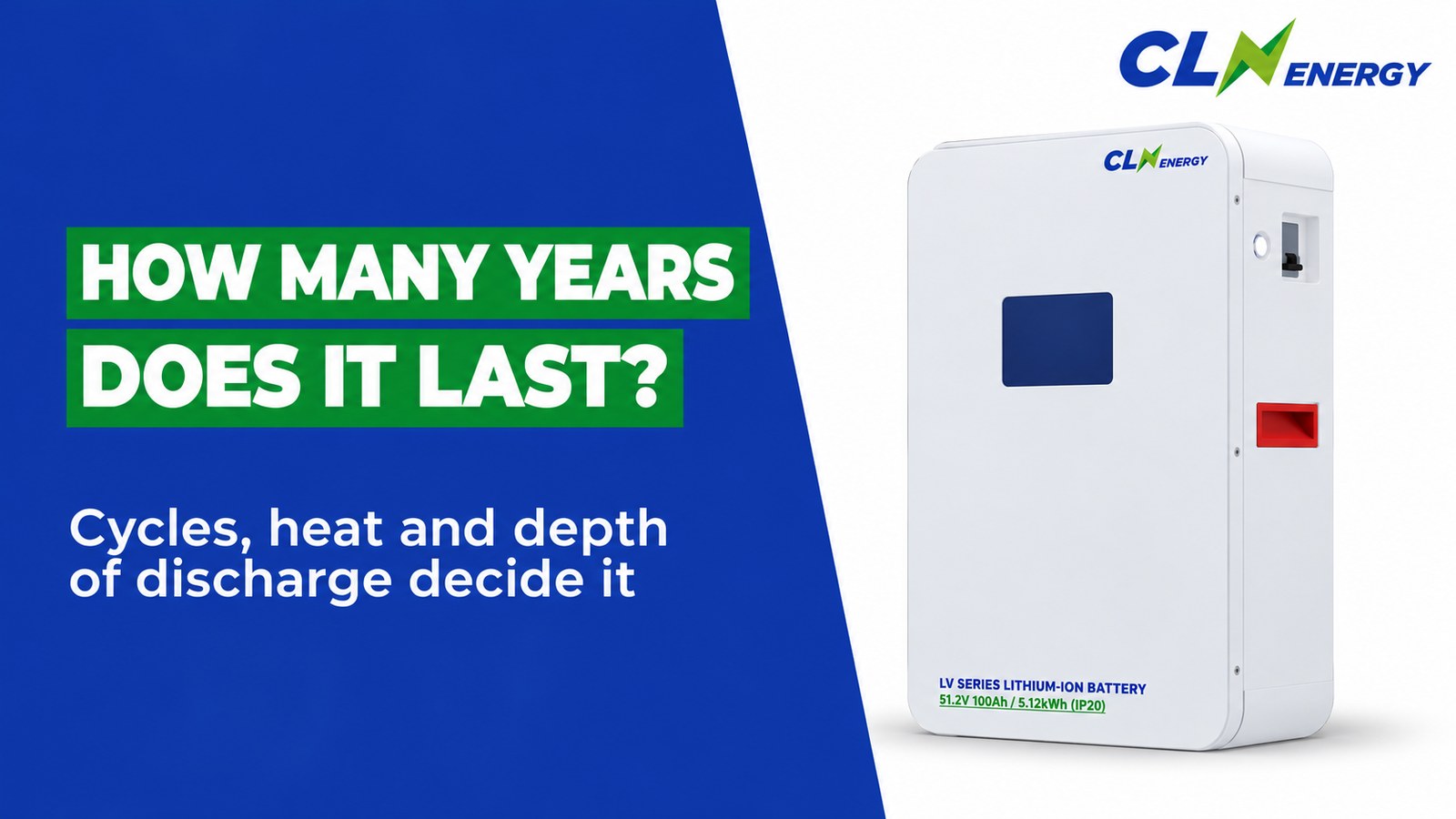




Comments: