
By CLN Energy Limited BSE SME listed, scrip 544347 Lithium battery manufacturer, Noida Published Updated
Two quotes arrive for the same requirement. Same voltage, same kilowatt-hours, and a difference between them large enough to make the decision look obvious. It usually is not, because the kilowatt-hours are the one thing the two batteries have in common. Seven things underneath that number are doing the work, and each of them is a question you can ask.
| What moves the cost | Costs more when | Ask the supplier |
|---|---|---|
| Cells | Better-matched cells from a named source | Which chemistry, format, supplier and grade? |
| Discharge rate | The energy must come out fast | What are the rated and peak C-rates? |
| Battery management | Active balancing, remote reporting | What does the BMS protect and report? |
| Enclosure | Outdoor, in a vehicle, IP67, vibration | What IP rating, for what environment? |
| Certification | More standards apply to the use | Which reports cover this exact model? |
| Warranty and service | Longer term, engineers nearby | How many months, and who honours it? |
| Volume and design | Custom size, voltage or connector | Is this a catalogue product or a new design? |
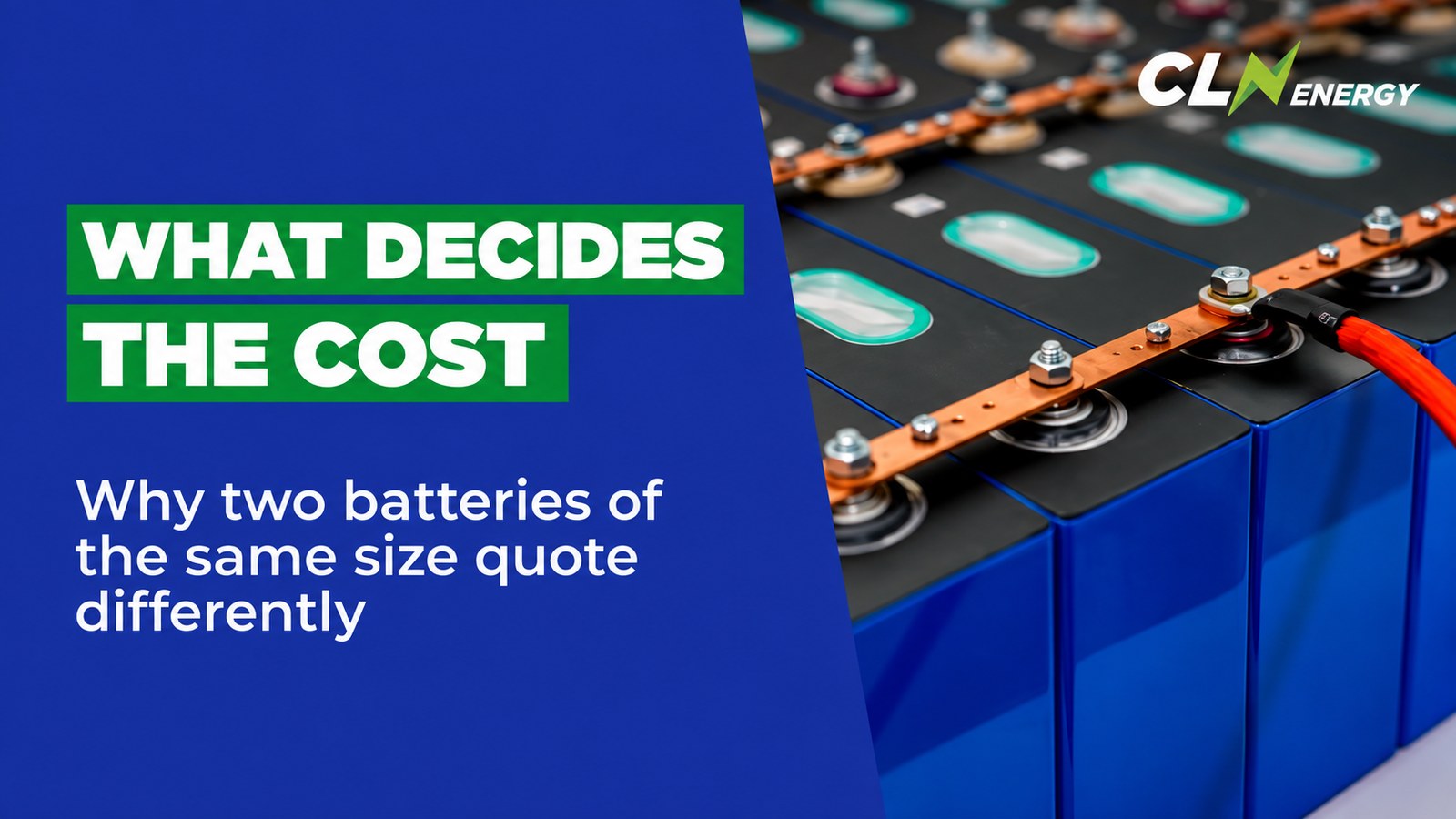
Cells are most of what a battery costs, and they are not interchangeable. Chemistry comes first — lithium iron phosphate against the nickel-based chemistries — and then, within the same chemistry, grade. Cells are sorted by how closely they match each other in capacity and internal resistance, and a pack built from well-matched cells holds its capacity for longer because the weakest cell decides when the pack is empty.
Ask: what chemistry, what cell format, whose cells, and what grade. A supplier who cannot answer is selling somebody else's decision, and any price difference underneath it is unexplained rather than cheap.
A battery rated to deliver its energy in four hours and one rated to deliver the same energy in ten minutes are different machines. The fast one needs cells built for the current, thicker busbars and connections, more attention to heat — and it costs more for exactly the same kilowatt-hours.
This is why our own data-centre range is split in two: a 5 to 15 minute series rated to 6C, and a 30 to 60 minute series rated to 2C. If a quote does not state the discharge rate, the capacity on it is only half a specification.
Every pack has one. What separates them is what they do and what they tell you. A basic BMS protects against over and under voltage, over current, short circuit and temperature. A better one balances the cells actively, and reports state of charge, state of health and cell temperatures over RS485 or CAN to whatever is watching the site.
On a telecom site or in a plant room that reporting is not a luxury — it is the difference between visiting a site because the data said so and visiting it after the load has already dropped. It is a real cost in the pack and a real saving outside it.
An indoor rack module and a pack that will sit under a vehicle or outdoors on a tower site are built differently. Ingress protection, vibration resistance, the enclosure material, the connectors, whether the pack is sealed. Our L3 and L5 e-mobility packs are IP67 rated because of where they live; an indoor 19-inch telecom module does not need to be, and it would be wasteful to pay for it.
Testing is expensive, and the tests that apply depend on the application: UN 38.3 for transport, IEC 62619 for industrial cell and battery safety, IEC 61000 for electromagnetic compatibility, UL 1973 for stationary systems, AIS 156 for electric vehicles in India, T-SEC for telecom. A supplier who has done the testing for your application carries that cost; one who has not may be quoting a pack that cannot legally or practically be used where you intend to put it. What each standard covers is worth ten minutes before comparing quotes.
A warranty is a priced promise. A longer term costs the manufacturer more because they expect to service some of it, and terms vary by duty — ours run from 36 months on e-mobility packs to 60 on material handling, telecom and most stationary products, 84 on the liquid-cooled 100 kW/215 kWh unit and 120 on the 1 MWh BESS, because those duty cycles are not comparable.
Then the part that is not on the quote at all: who answers the phone. A warranty administered from abroad, or by a trader who imported the pack, is a different thing from one honoured by the company that built it a few hours' drive away.
A catalogue product built in volume costs less to make than a pack designed around your enclosure, your voltage and your connector. That is not a reason to avoid a custom pack — it is often the only thing that fits — but it explains a gap between two quotes when one supplier has quoted the nearest standard product and the other has quoted what you actually asked for. Make sure you are comparing the same thing before you compare the numbers.
Cost per kilowatt-hour is the wrong unit, because it ignores how many times you can use those kilowatt-hours. The honest comparison is what the battery costs across the years you will own it, and it needs five things from each quote:
| Put both quotes on the same terms | Quote A | Quote B |
|---|---|---|
| Usable energy (kWh × rated depth of discharge) | ||
| Cycle life, with DOD, temperature and C-rate | ||
| Rated and peak discharge current | ||
| Certificates for this model | ||
| Warranty months, and what voids it | ||
| Who services it, and from how far | ||
| Capacity retained at end of rated life | ||
| Price ÷ (usable kWh × cycles) |
That last line is the cost of each kilowatt-hour the battery will deliver over its rated life, and it is the fairest single figure to compare. A pack that lasts twice as many cycles for a higher price is cheaper. A pack that is unavailable for three days when it fails may be the most expensive thing in the room, depending on what it was backing up.
Because a number on a page is answered with a question we would rather ask first: for what duty, at what discharge rate, in what enclosure, to what certification, with what warranty. Two packs of the same capacity can differ by a factor that has nothing to do with either one being overpriced. Tell us the application and the numbers come back specified, not guessed.
That is not the same as hiding the arithmetic. For stationary battery energy storage we publish indicative budget ranges per usable kWh — deliberately wide, approximate, and meant for budgeting rather than as a quotation, because every system is engineered to its site. For vehicle packs the configuration decides too much for a range to carry useful meaning, so those are quoted against the vehicle and the duty.
If your requirement is a standard product, the ranges are under our products. If it is not, how a custom pack is specified sets out what we need from you to quote it properly.
The purchase price is higher because the cells, the battery management system and the testing all cost more to produce. The comparison that decides the money is not the invoice but how many times you buy a battery over the same years: a lithium iron phosphate pack rated for thousands of cycles at a stated depth of discharge, against however often the lead-acid set is currently replaced under the same duty.
Put them on the same terms first. Usable energy rather than rated capacity, cycle life with the depth of discharge and temperature it was measured at, the discharge rate each is built for, the certificates that apply to your application, the warranty term for your duty, and who honours it from where. Quotes that look far apart usually differ on two or three of those.
Divide the price by the usable energy multiplied by the rated cycles — usable energy being capacity times the depth of discharge the cycle rating assumes. That gives the cost of each kilowatt-hour the battery delivers over its rated life, so two quotes of different sizes and cycle ratings can be compared on the same footing.
Not necessarily more per unit of energy, and not in the way that matters. A pack built to deliver its energy in ten minutes costs more than one delivering the same energy over four hours, because the cells, the connections and the thermal design are different. Capacity is only one of the numbers setting the price.
Because the same capacity covers many different products. Voltage, discharge rate, enclosure and ingress rating, certification, communication, warranty and volume all move the figure, and a single published number would be wrong for nearly everyone who read it. Sending the application — the load, the hours, where it sits and what it connects to — is what gets a figure that means something.
Standards and government figures link to the organisation that publishes them. Figures about CLN products and deployments come from our own specification tables and project records, linked here so they can be checked. CLN Energy is one of the lithium battery manufacturers in India that buys cells and builds the pack itself, which is why these cost drivers are described from the inside.
Looking for the batteries themselves? Custom lithium battery packs →
Our energy storage website sets out what an energy storage system costs per kWh.

 Become a
Partner
Become a
Partner



Comments: