
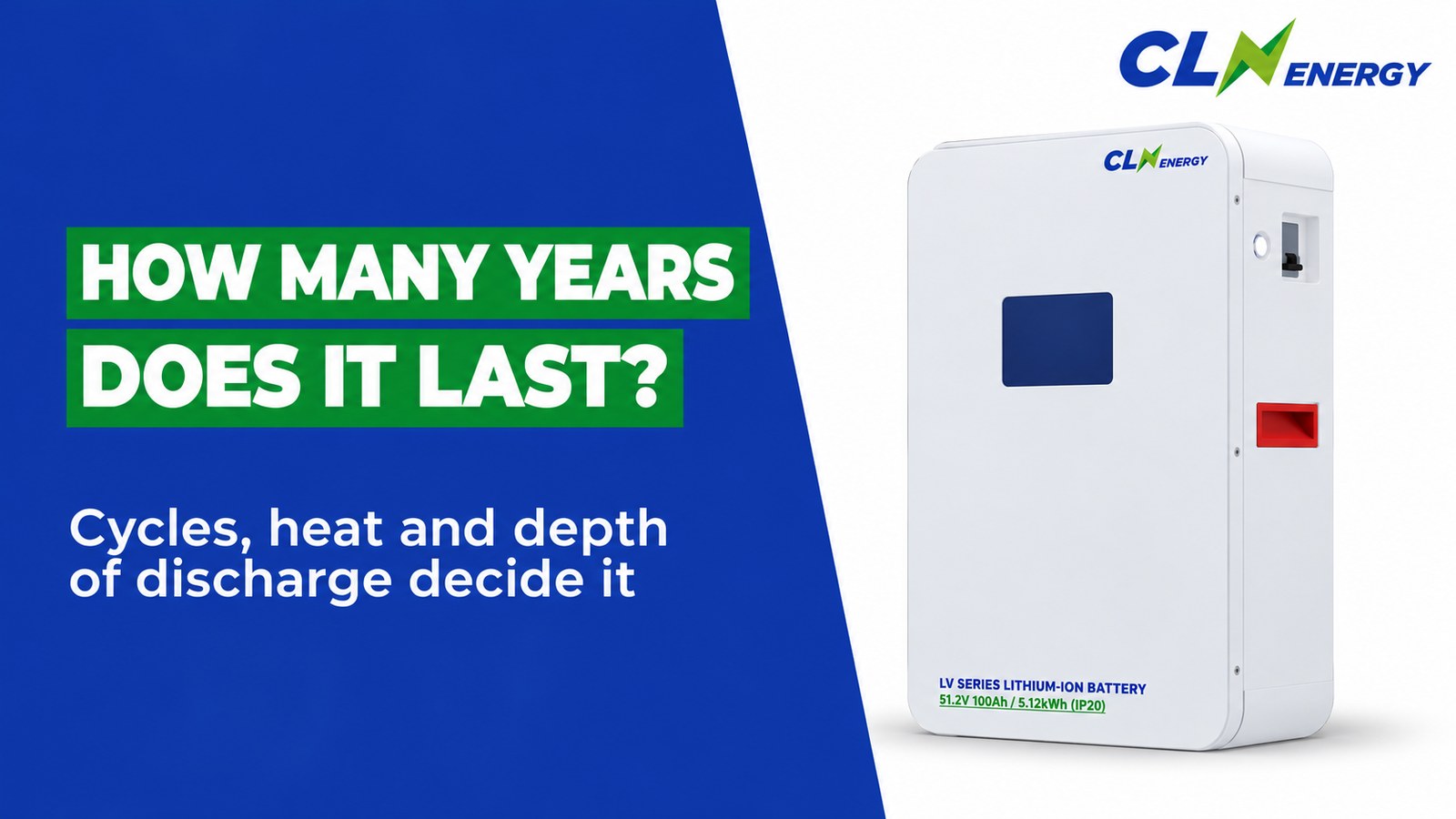
It depends less on years than on use. A lithium battery is rated in charge cycles, not years, so how long it lasts comes from how many cycles it is rated for, how many of them you use each year, how deeply you discharge it and how hot it gets. A lithium iron phosphate battery rated for 3,000 cycles and used once a day has about eight years of cycling in it; one rated for 6,000 has far more — but time and heat age a battery too, so the cycle rating is a ceiling, not a promise.
This guide turns cycle ratings into years, shows what the ratings on our own batteries mean, and covers what shortens a battery's life and what stretches it.
One cycle is one full charge and discharge at the depth of discharge the rating assumes. Two half discharges count as roughly one cycle. That is why a rating has to come with its conditions: 3,000 cycles at 95% depth of discharge, 25°C, 0.5C charge and discharge is a specification you can plan with; "3,000 cycles" on its own is not.
A rating also ends at a point: the battery is not dead after its last rated cycle, it has fallen to a defined share of its original capacity and keeps working with less. Ask what capacity the rating ends at, because a battery at the end of its rated life may still meet a light load and no longer meet a heavy one.
Divide the rated cycles by the cycles you use in a year. How many you use depends almost entirely on the job the battery does:
| How the battery is used | Cycles in a year, roughly | Years to use 3,000 cycles | Years to use 6,000 cycles |
|---|---|---|---|
| Deep discharge every day (daily outages, e-rickshaw, off-grid solar) | 365 | 8.2 | 16.4 |
| Five working days a week | 260 | 11.5 | 23 |
| A few outages a week, partly discharged | 100 or fewer | 30+ | 60+ |
The last row is where the arithmetic stops being useful. A battery that is rarely cycled is limited by age, not by its cycle rating: lithium cells slowly lose capacity with time even when they are not being used, faster when they are kept hot or held fully charged. So a battery that cycles every day will usually reach the end of its cycle rating first, and one that sits on standby will usually reach the end of its calendar life first. Either way, the rating tells you how much work the battery can do; it does not tell you how many birthdays it will see.
Ratings differ across a range because the batteries do different jobs. These are the figures from our specification tables:
| CLN battery | Rated cycle life | Warranty |
|---|---|---|
| Table Top 12.8V and 25.6V 100Ah (home inverter) | 3,000 at 95% DOD, 25°C, 0.5C/0.5C | 5 years |
| Wall Mounted and Ground Mounted (home and solar) | 6,000 at 95% DOD | 5 years |
| Stackable BESS 48V, 4.8 to 19.2 kWh | 6,000 at 95% DOD | 60 months |
| Stackable All-in-One 5 kW, 10 to 20 kWh | 6,000 at 95% DOD | 5 years |
| 48V telecom modules | 3,000 at 90% DOD, 25°C, 0.5C/1C | 60 months |
| Data-centre UPS series | 3,000 at 80% DOD, 0.5C/0.5C | — |
| L3 e-rickshaw and L5 e-auto packs | Ask for the model's figure | 36 months |
Keep the two columns apart in your head. Cycle life is an engineering rating measured under stated conditions. Warranty is a commercial promise, shorter, and it is the part you can hold the manufacturer to.
| Cause | What it does | What to do |
|---|---|---|
| Heat | Speeds up both calendar ageing and wear from cycling | Keep it out of direct sun and away from cooking heat; check the rated working temperature |
| Discharging deeper than the rating assumes | Uses the battery harder than the cycle figure was measured at | Size the battery so a normal outage does not empty it completely |
| Charging or discharging faster than rated | Stresses the cells and raises their temperature | Keep charge current within the rating — 30 A recommended on our Table Top packs |
| The wrong charge setting | Leaves it permanently undercharged, or pushes it harder than it needs | Set the inverter or charger for lithium, matched to the pack's charging voltage |
| Long storage full or empty | Ages the cells faster than storage at partial charge | Store partly charged, within the storage temperature range |
Every CLN pack has a battery management system that stops the cells being over-charged, over-discharged, over-heated or short-circuited, and balances them. That prevents damage; it does not change the physics of heat and depth, which is why the conditions above still matter.
Where power cuts are daily, a home battery cycles close to once a day and its cycle rating is what sets its life. Where cuts are rare, it spends most of its life on standby, and age and room temperature matter more than cycles. Can I use a lithium battery in a normal inverter? covers sizing it so it is not emptied completely in a normal outage.
A solar battery usually cycles every day, charged by the panels and discharged in the evening, which is the duty the 6,000-cycle wall, ground-mounted and stackable ranges are built for. The solar lithium battery page sets out on-grid, hybrid and off-grid side by side.
A commercial electric three-wheeler discharges deeply every working day, so it uses cycles faster than any other duty here. That makes the depth of discharge and the charger matter more, and makes the warranty terms worth reading closely. LiFePO4 or lead-acid for an e-rickshaw fleet works through the fleet arithmetic.
A telecom site on an unreliable grid can cycle daily; a data-centre UPS may discharge only a handful of times a year and is limited by age and room temperature instead. That is why a data hall's steady 20–25°C matters as much as the cycle rating.
Divide its rated cycles by the cycles you use in a year. A lithium iron phosphate battery rated for 3,000 cycles and used once a day has about eight years of cycling in it; one rated for 6,000, about sixteen. Heat, deep discharges and the passage of time age it as well, so treat those figures as a ceiling. The warranty — five years on our residential range — is the part that is guaranteed.
The amp hours do not decide the years; the cycle rating, depth of discharge and temperature do. A 100Ah battery tells you how much energy it holds, not how long it lives. Our 12.8V and 25.6V 100Ah Table Top packs are rated for 3,000 cycles at 95% depth of discharge, which is about eight years of daily use, with a five-year warranty.
Not on a date, but they do age with time. A lithium battery slowly loses capacity even when unused, faster when stored hot or fully charged. Stored partly charged and within its storage temperature range — 0 to 45°C for our Table Top packs — it ages slowly, but a battery that has sat on a shelf for years will not have the capacity of a new one.
A life cycle, or cycle life, is the number of full charge and discharge cycles a battery is rated for under stated conditions — depth of discharge, temperature and charge rate — before its capacity falls to a defined share of the original. It is a rating of how much work the battery can do, not of how many years it will last.
It varies by product and duty, so check the term for the exact model. Ours run from 36 months on e-rickshaw and e-auto packs to 60 months on telecom, material handling and stackable storage, five years on the residential range, 84 months on the liquid-cooled 100 kW/215 kWh unit and 120 months on the 1 MWh BESS.
Where it cycles regularly, usually much longer, because lithium iron phosphate is rated for thousands of cycles at a deep depth of discharge while lead-acid is conventionally used to only about half. The honest comparison is how many batteries you buy over the same years for the same job, and most households and fleets already know how often their lead-acid battery is replaced.

 Become a
Partner
Become a
Partner




Comments: