
By CLN Energy Limited BSE SME listed, scrip 544347 Lithium battery manufacturer, Noida Published Updated
A telecom site fails in a way few other installations do: quietly, at three in the morning, somewhere nobody visits for a week. Sizing the battery correctly is most of what stops that, and the arithmetic is short enough to do on the way to the site. What follows is that arithmetic, then the three things that decide whether the bank you sized actually lasts.
A telecom bank works at 48V, so convert the site load to current before anything else. A 1,500 W site draws roughly 1,500 ÷ 48 = 31 A. Do this with the real load rather than the rectifier's rating: a 3 kW rectifier feeding a 1.2 kW site sizes a bank you will never need and pay for twice.
Autonomy is what the site has to ride through, in hours. Multiply. That 31 A site needing eight hours of backup needs 31 × 8 = 248 ampere hours of usable energy. Note the word usable — it is where lead-acid and lithium part company.
A lead-acid string is conventionally sized so that it is only half emptied, because taking it deeper shortens its life sharply. So 248 usable amp hours means buying roughly 500 rated. Lithium iron phosphate is cycled far deeper as a matter of routine — our telecom packs are rated at 3,000 cycles at 90% depth of discharge, 25°C, 0.5C charge and 1C discharge — so the usable figure and the rated figure are close. The 248 Ah site lands on three 100Ah modules rather than a 500 Ah lead-acid string.
Usable capacity here is taken at the 90% depth of discharge our telecom modules are rated at. Load growth and capacity fading over the years are worth a margin on top.
| Site load | Current at 48V | Autonomy | Amp hours needed | 100Ah modules | Usable at 90% DOD |
|---|---|---|---|---|---|
| 1,000 W | 20.8 A | 4 h | 83 Ah | 1 | 90 Ah |
| 1,200 W | 25 A | 6 h | 150 Ah | 2 | 180 Ah |
| 1,500 W | 31.3 A | 8 h | 250 Ah | 3 | 270 Ah |
| 2,000 W | 41.7 A | 8 h | 333 Ah | 4 | 360 Ah |
That is the whole sizing exercise. The rest of this article is about the things that decide whether the bank survives the site.
Lead-acid is rated at 25°C and loses roughly half its design life for every 10°C above that. An unconditioned shelter at 40°C in an Indian summer is therefore consuming a four-year battery in about one, which is why so many sites are on a replacement cycle measured in months rather than years.
The useful question to ask about any pack, ours included, is what temperature range it is rated to work in, not what it survives. Our 48V telecom modules are rated 0 to 55°C working and 0 to 45°C storage. If a supplier quotes cycle life without naming the temperature it was measured at, the number is not a specification.
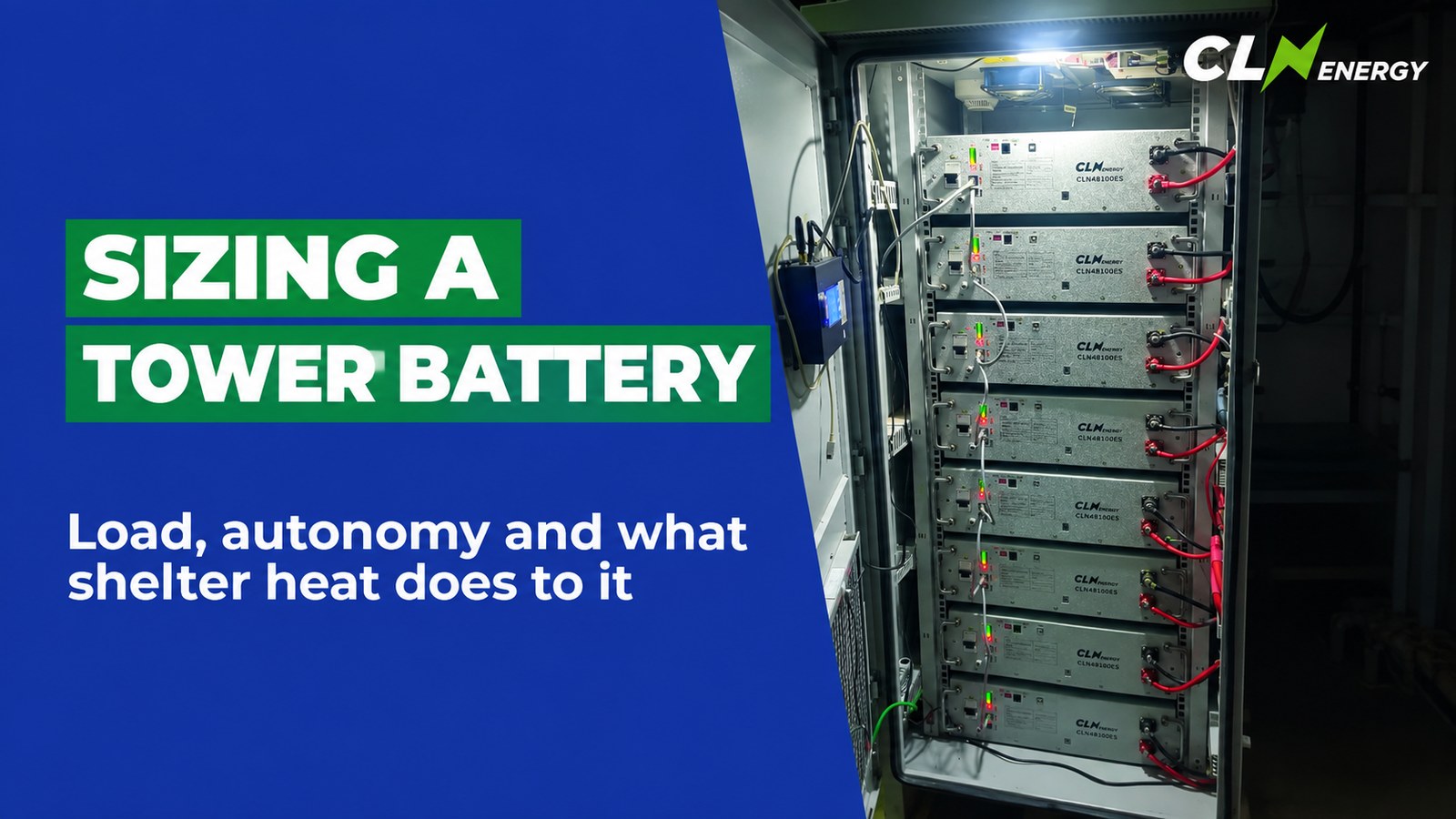
Most telecom banks go into a 19-inch rack beside the rectifier, and the physical detail is what turns a good specification into an installation that works:
| Specification | 48V 50Ah | 48V 100Ah |
|---|---|---|
| Format | 19-inch, 3U | 19-inch, 3U |
| Cells | LFP, prismatic, 15 in series | LFP, prismatic, 15 in series |
| Size | 482 × 480 × 133 mm | 580 × 482 × 134 mm |
| Weight | About 32 kg | About 52 kg |
| Cycle life | 3,000 at 90% DOD, 25°C, 0.5C/1C | |
| Working temperature | 0–55°C | |
| Communication | RS485 / CAN | |
| Warranty | 60 months | |
Capacity is added by putting modules in parallel, and packs that are meant to be paralleled say so: ours use a master and slave arrangement between the battery management systems so the modules share load and report as one bank rather than fighting each other. Ask explicitly how many modules a supplier supports in parallel, and whether mixing a new module with modules already in service is allowed — that is the question that decides whether year four is an expansion or a replacement.
On a network of any size, the battery is not the cost. The truck is. A pack that reports state of charge, temperature and health over RS485 or CAN turns an emergency visit into a scheduled one, because the site tells you it is degrading before it fails.
This is the whole argument of the largest deployment we have done: 22,864 packs across BSNL's network, each reporting to a dashboard, with a five-year warranty and a further five-year AMC behind them. The change that mattered was not the chemistry. It was that a site is now visited because its data says it needs attention.
A site draws 1.2 kW and needs six hours of autonomy. 1,200 ÷ 48 = 25 A. 25 × 6 = 150 Ah usable. Two 100Ah modules give 200 Ah, which covers it with margin for the load growing and for capacity fading over the years — 6U of rack and about 104 kg. One 50Ah module plus one 100Ah would meet the number exactly, but mixed capacities in parallel are a compromise worth avoiding where the rack has the space.
The full range with each model's specification is on the telecom tower battery page. For a site that does not fit the standard modules — an unusual voltage, an enclosure that has to match an existing tray — custom packs covers how one is specified.
Divide the site load in watts by 48 to get amps, then multiply by the hours of autonomy you need. A 1,500 W site needing eight hours works out at 1,500 ÷ 48 × 8 = 248 Ah. With lithium iron phosphate that figure is close to the rated capacity you buy, because the pack is cycled deep as a matter of routine; a lead-acid string is usually sized at roughly twice the usable figure.
It follows the site's load and the autonomy it needs. A 1,500 W tower needing eight hours of backup needs about 250 Ah at 48V, which is three 100Ah lithium modules — 9U of rack and about 156 kg. A 1,200 W site needing six hours needs two modules, 6U and about 104 kg.
Divide the site load in watts by 48 to get amps, multiply by the hours of autonomy, and divide by the usable capacity of one module — 90 Ah for a 100Ah module at 90% depth of discharge. A 1,500 W site needing eight hours needs 250 Ah, so three modules; a 1,200 W site needing six hours needs two.
Heat, mostly. Lead-acid is rated at 25°C and loses roughly half its design life for every 10°C above that, so an unconditioned shelter running at 40°C consumes a four-year battery in about one. Partial-state-of-charge cycling on unreliable grid power takes another bite. Lithium iron phosphate tolerates both far better, which is why the replacement cycle stretches from months to years.
It depends on the pack's battery management system, so ask for the number rather than assuming it. Ours use a master and slave arrangement so paralleled modules share the load and report as a single bank. Ask the same supplier whether a new module may be added alongside modules already in service, and what that does to the warranty.
Our 48V 50Ah and 100Ah modules are 19-inch 3U units, 580 × 482 × 134 mm, with the 100Ah weighing about 52 kg. A 200 Ah bank is two modules: 6U and roughly 104 kg, which is worth checking against the rack's load rating before delivery rather than on the day.
Standards and government figures link to the organisation that publishes them. Figures about CLN products and deployments come from our own specification tables and project records, linked here so they can be checked. The module dimensions and weights are CLN Energy's own; it is one of the lithium battery manufacturers that builds and tests 48V telecom modules at its Noida plant.
Looking for the batteries themselves? Telecom tower lithium batteries →
Our energy storage website sets out how to size battery storage for a building.

 Become a
Partner
Become a
Partner



Comments: