CLN Energy makes the parts of a solar system that store and convert the power: all-in-one solar units with a built-in MPPT charger and LiFePO4 battery, lithium batteries that store power from solar panels and pair with a solar or hybrid inverter, and grid-tie solar inverters from 1 kW to 5 kW — all built at the Noida plant. Which you need turns on one question: do you want power during a grid outage? The guide below answers it, with every product linked to its full specification.
By CLN Energy Limited BSE SME listed, scrip 544347 Lithium battery manufacturer, Noida Reviewed
There are three ways to put solar on a building, and the difference between them is the battery. An on-grid system uses none: the inverter feeds solar power to the house and the grid, and shuts down in a power cut. A hybrid system adds a battery, so the panels charge it by day and it carries the load through an outage or the evening. An off-grid system runs on panels and battery alone, with no grid connection at all. Most homes in India that want backup choose hybrid; most that only want a smaller bill choose on-grid.
| Setup | Battery | Power in a grid outage | CLN products |
|---|---|---|---|
| On-grid | None | No — the inverter must shut down | Grid-tie solar inverters |
| Hybrid | Yes | Yes, from the battery | All-in-one solar units, or a lithium battery with a hybrid inverter |
| Off-grid | Yes | Not connected to the grid | Lithium batteries with an off-grid inverter |
Inverter, MPPT solar charger and lithium iron phosphate battery in one enclosure. Each unit takes power from the panels, the battery or the grid and delivers single-phase pure sine wave output; the solar input each model accepts is on its specification page. It is the simplest route to solar backup for a home or shop: one box, no separate charge controller, no battery bank to wire.
| Model | Power rating | Battery voltage | Format |
|---|---|---|---|
| All-in-one Wall mount 900VA/12.8V | 900 VA | 12.8V | Wall mount |
| All-in-one Wall mount 1100VA/12.8V | 1,100 VA | 12.8V | Wall mount |
| All-in-one Wall Mount 1600VA/25.6V | 1,600 VA | 25.6V | Wall mount |
| All-in-one Table Top 2000VA/25.6 | 2,000 VA | 25.6V | Table top |
| All-in-one Wall Mount 2000VA/25.6V | 2,000 VA | 25.6V | Wall mount |
| All-in-one Table Top 3000VA/25.6V | 3,000 VA | 25.6V | Table top |
| Stackable All-in-one 5kW/51.2V 10kWh | 5 kW | 51.2V | Stackable |
| Stackable All-in-one 5kW/51.2V 15kWh | 5 kW | 51.2V | Stackable |
| Stackable All-in-one 5kW/51.2V 20kWh | 5 kW | 51.2V | Stackable |
Powering a whole home or a business? The All-in-One Home, Prime and Pro series, from 5 kW upward, are on our energy storage site: All-in-One Home Series.
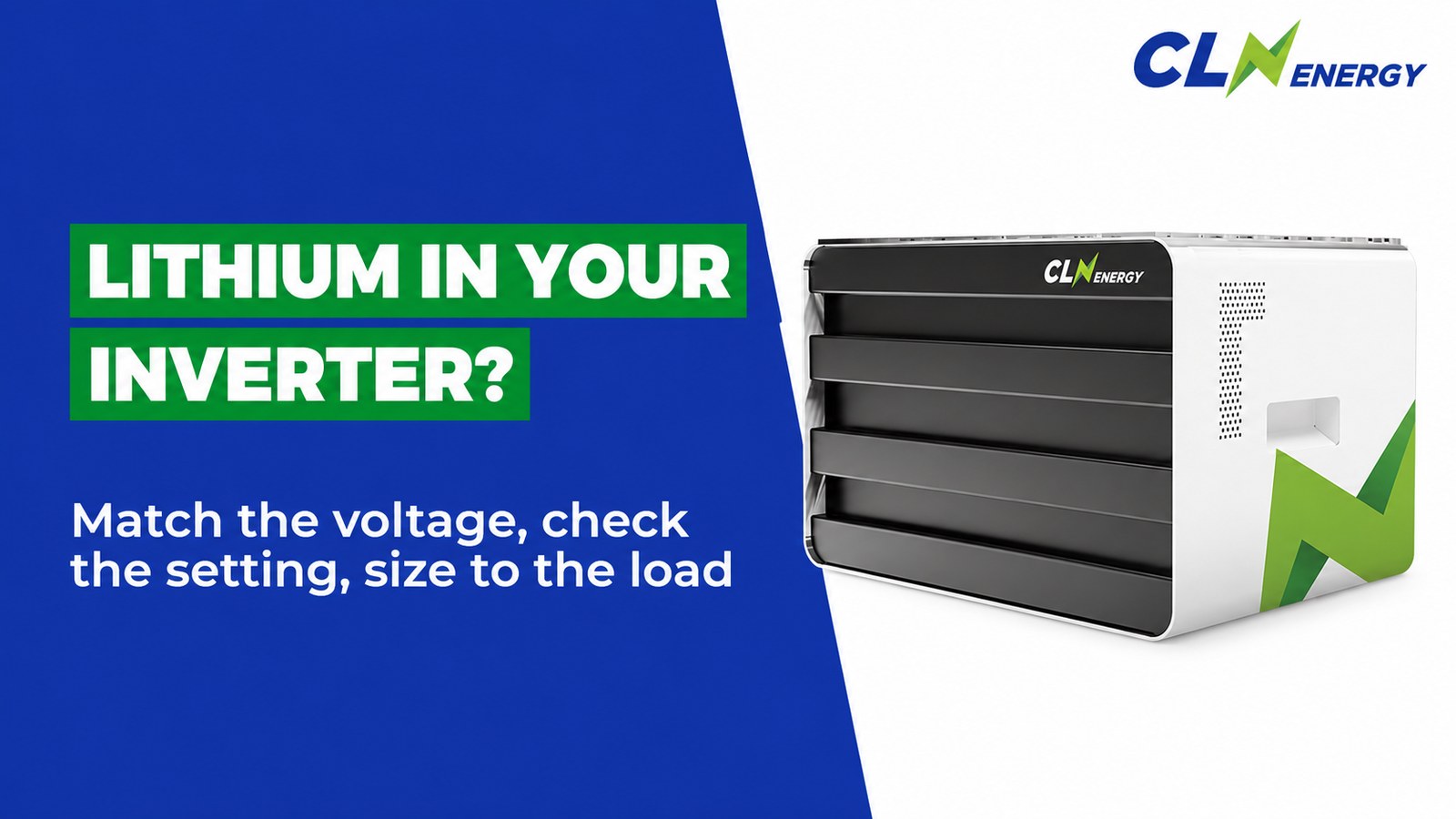
Already have a solar or hybrid inverter, or choosing one separately? Almost every CLN battery can sit behind a solar inverter; these are the residential sizes. Match the battery voltage to the inverter's battery input — 12.8V for a 12V inverter, 25.6V for 24V, 48V or 51.2V for 48V — and size the capacity to the load.
| Model | Voltage | Capacity | Nominal energy |
|---|---|---|---|
| Table Top Battery 12.8V 100Ah | 12.8V | 100 Ah | 1.28 kWh |
| Table Top Battery 25.6V 100Ah | 25.6V | 100 Ah | 2.56 kWh |
| Stackable BESS 4.8 kWh | - | - | 4.8 kWh |
| Wall Mounted Battery 48V 100Ah | 48V | 100 Ah | 4.8 kWh |
| Wall Mounted Battery 25.6V 200Ah | 25.6V | 200 Ah | 5.12 kWh |
| Wall Mounted Battery 51.2V 100Ah | 51.2V | 100 Ah | 5.12 kWh |
| Ground Mounted Battery 25.6V 230Ah | 25.6V | 230 Ah | 5.89 kWh |
| Ground Mounted Battery 25.6V 314Ah | 25.6V | 314 Ah | 8.04 kWh |
| Stackable BESS 9.6 kWh | - | - | 9.6 kWh |
| Ground Mounted Battery 51.2V 230Ah | 51.2V | 230 Ah | 11.78 kWh |
| Stackable BESS 14.4 kWh | - | - | 14.4 kWh |
| Ground Mounted Battery 51.2V 314Ah | 51.2V | 314 Ah | 16.08 kWh |
| Stackable BESS 19.2 kWh | - | - | 19.2 kWh |
| Stackable Lithium-ion Battery 2.0 | - | - | See specification |
Larger banks: every 48V and 51.2V pack, including the stackable commercial systems, is on the 48V lithium battery page. Swapping out a tubular lead-acid battery? See lead-acid to lithium replacement.
On-grid inverters for rooftop solar, transformerless, with a single MPPT tracker working across 70–500 Vdc. Maximum efficiency is 97.5%, the enclosure is IP65 for outdoor mounting, and monitoring runs over RS485 or RS232 with Wi-Fi, GPRS, 4G or LAN as options. The specification lists IEC 61727 and IEC 62116 for grid connection and IEC 62109-1 and -2 for safety. The range is BIS certified, supports zero-export operation for sites that may not feed power back to the grid, and starts up from 80V.
A grid-tie inverter uses no battery and shuts down when the grid fails. If you want backup as well as a lower bill, look at the all-in-one units above instead.
At a government school in Ballia, Uttar Pradesh, a 20 kW hybrid inverter with a 69 kWh CLN battery bank carries the school's load through outages — installed for UP NEDA, the state's new and renewable energy agency, in 2023. At a manufacturer in Faridabad, a 10 kW hybrid inverter with 19.2 kWh of CLN storage, integrated with the plant's solar array, holds the critical load for about three and a half hours and cuts the bill on every day the grid behaves. Both are the same hybrid principle as the all-in-one units above, at the scale of a building. Every installation is listed with its real configuration on the projects page, and the standards each battery is built and tested to are explained on the certifications page.
Yes, and lithium iron phosphate in particular suits the job. A solar battery cycles every day - charged by the panels, discharged through the evening - so the number of cycles a battery can deliver matters more than almost anything else, and cycle life is where LiFePO4 is strongest. It also needs no topping up, accepts charge quickly, which matters when the sun is only up for so many hours, and carries a battery management system that protects the cells and balances them. CLN builds every battery on LiFePO4 at its plant in Noida, and the rated cycle life is stated per model on each specification page. The one real trade is size: an LFP battery is larger for the same energy than the nickel-based chemistries, which is rarely a constraint in a home or on a wall.
The one whose voltage matches the inverter's battery input, sized to the load. Voltage first: a 12V inverter takes a 12.8V lithium battery, a 24V inverter takes 25.6V, and a 48V inverter takes a 48V or 51.2V pack - the lithium numbers are slightly higher because a LiFePO4 cell is 3.2V rather than 2V. Then capacity, which is arithmetic on the load and the hours of backup you want. Last, the inverter must charge with a lithium profile or be set to one; some hybrid inverters also talk to the battery management system directly. Almost every CLN battery can sit behind a solar inverter. Send us the inverter model and the load, and we will name the battery rather than leave you to guess from a catalogue.
Usually, provided the voltage matches and the charge settings suit lithium. Most home inverters in India were installed with tubular lead-acid batteries and are set to a lead-acid charge profile. On a lithium battery that profile tends to stop short of a full charge, so part of the capacity you paid for goes unused; the battery management system in every CLN pack protects the cells, so the usual result is lost capacity rather than damage. Many inverters have a battery-type setting that fixes this; some older ones do not. The CLN table-top batteries are built to standard lead-acid form factors, so they usually fit where the old battery stood. Tell us the inverter make, model and battery voltage, and we will confirm whether it suits a 12.8V or 25.6V CLN battery as it stands, or what needs to change. The lead-acid replacement page covers the swap in detail.
No, and this is the most common surprise in rooftop solar. A grid-tie inverter feeds solar power into your home and the grid, and it uses no battery. When the grid fails it is required to shut down - anti-islanding protection, specified under IEC 62116 - so that it cannot push power onto a line that engineers may be working on. That means panels on the roof and no power in the house during an outage, even at midday. If you want power through a cut, you need a hybrid setup: an inverter that works with a battery, such as a CLN all-in-one solar unit, or a hybrid inverter paired with a CLN lithium battery. A grid-tie inverter is the right choice where the aim is to cut the electricity bill and outages are rare.
Multiply the load you want to run by the hours you want to run it, then allow for how deeply you will discharge. Say 500 watts of fans, lights and a refrigerator for four hours: that is 2 kWh. A 25.6V 100Ah battery stores 2.56 kWh nominal, and at 80% depth of discharge - the depth CLN rates its cycle life at - it delivers about 2.05 kWh, which covers it with a little margin; inverter losses eat into that margin, so round up rather than down. Use the real load, not the inverter's rating: an inverter rated 2,000 VA running 500 watts empties a battery at the 500-watt rate. For a whole home or a business, the sizing is worth doing properly - send us the load and the hours and we will size it.
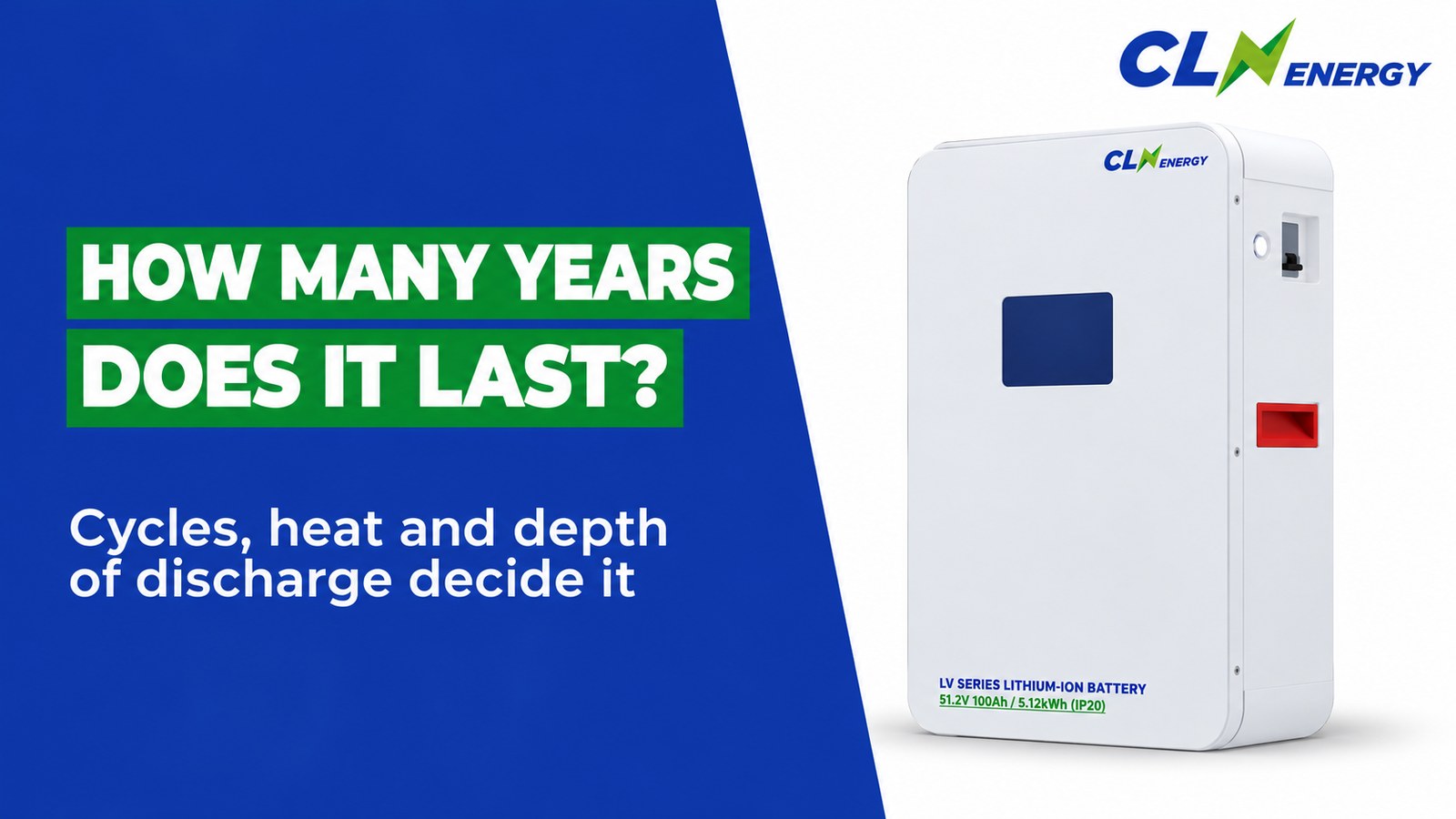
It is rated in cycles. CLN wall-mounted, ground-mounted and stackable batteries are rated for 6,000 cycles at 95% depth of discharge, which as arithmetic is about sixteen years of one cycle a day. Heat and age shorten real life, so treat that as a ceiling rather than a promise. The residential range carries a five-year warranty.
It varies by manufacturer and product, so check the term for the exact model. CLN batteries for home and business solar - wall-mounted, ground-mounted, stackable and all-in-one units - carry five years. Warranty is the commercial promise and the cycle rating is the engineering figure; read the two together.
Answers to the questions buyers ask before choosing a battery, written from our own specification tables and deployments.
The load you want to run, the hours of backup, and the inverter if you already have one. That is enough to come back with the right battery or unit. CLN Energy is one of the li-ion battery manufacturers in India that builds its own residential and solar packs.
Request a quote Ask on WhatsApp Replacing lead-acid
 Become a
Partner
Become a
Partner