
By CLN Energy Limited BSE SME listed, scrip 544347 Lithium battery manufacturer, Noida Published Updated
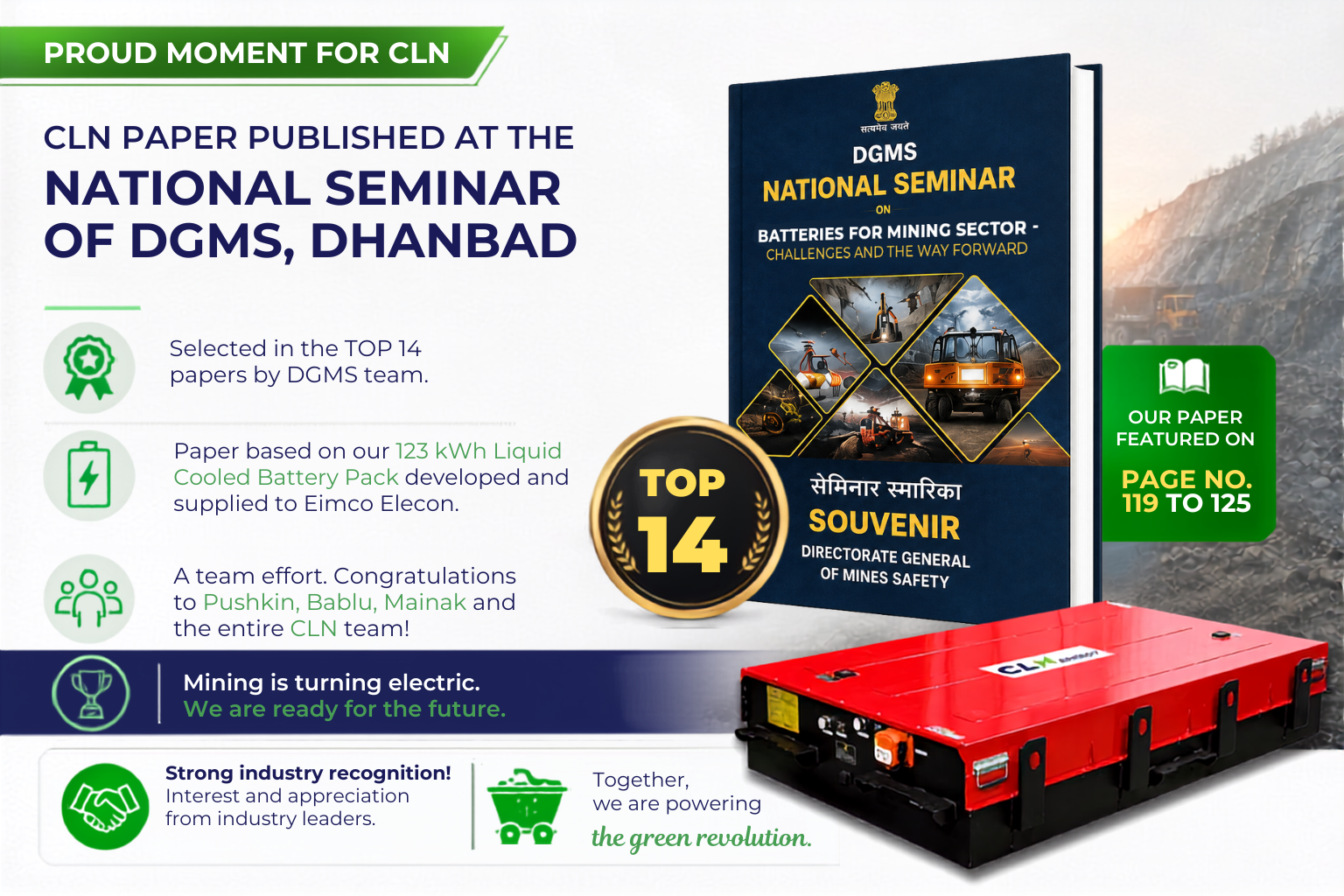
Thirty-six papers reached the technical panel at the Directorate General of Mines Safety in Dhanbad. Fourteen were selected for publication. Ours was one of them.
This article is based on our paper "Design, Safety and Deployment Experience of a Liquid-Cooled LFP Battery System for Underground Mining Applications" by Pushkin Gautam, Bablu Yadav and Mainak Bhanja of CLN Energy Limited page 119. It appears on pages 119 to 125 of the souvenir released at Batteries for Mining Sector – Challenges and the Way Forward (BMS-2026). DGMS organised the seminar with Mahanadi Coalfields Limited and held it at its headquarters auditorium in Dhanbad on 10 August 2026.
It combines a review of current battery technologies with practical engineering experience from a real-world project: a liquid-cooled LFP battery pack designed and built by our team for an underground passenger shuttle vehicle.
Download the paper (PDF, 7 pages) — or click any page reference to open it at that page.
The seminar's own objectives say why it was called. Among them: to identify the safety challenges associated with battery-powered mining equipment, and to discuss regulatory requirements and formulate recommendations and a roadmap. Its themes run to standards, testing and certification, explosion protection in hazardous mining environments, and safety standards and regulatory requirements.
That is a regulator preparing a settled position, not an industry showcase. Battery-electric equipment has moved past the pilot stage, and the approval framework has to catch up with it.
The case for electrification underground is easy to state. Diesel machines release exhaust into a confined space and add heat to air that is already warm. Ventilation has to carry both away, every hour of every shift. Battery-electric equipment removes the exhaust and lowers the heat load.
The safety case does not disappear; it moves. A high-voltage pack in a coal mine brings its own problems — thermal management, electrical safety, vibration resistance, charging infrastructure, explosion protection and regulatory compliance — and each has to be answered before the machine goes underground.
Lead-acid batteries have been used underground for decades, and for good reason. They are affordable, widely understood and supported by established manufacturing and maintenance practices. However, their weight, limited operating life, longer charging time and regular maintenance requirements make them less suited to the demands of modern battery-electric machines.
That moves the choice to lithium-ion, where the useful question is not which chemistry stores the most energy per kilogram. A machine that returns to a charging bay at the end of every shift does not need the highest energy density on the market. It needs a pack that behaves predictably when something goes wrong in a confined roadway. Thermal stability, abuse tolerance, cycle life and a lower risk of thermal runaway are what decide the choice — and on those, LFP has become the preferred chemistry for underground mining equipment.
Designing a battery for underground mining is not just about fitting enough energy into an enclosure. The pack has to keep working in hot conditions, withstand constant vibration and cope with the shocks and impacts of uneven underground haul routes.
These realities shaped the design from the beginning.
The liquid-cooling system helps maintain a consistent temperature throughout the pack, even when the surrounding environment becomes hot. This matters because cells perform best when they operate under similar conditions. Keeping temperatures balanced supports predictable performance and helps the pack age more evenly over its working life.
The enclosure was designed with the same operating environment in mind. Its robust construction, secure mounting and vibration protection help shield the battery and its internal components from the continuous movement and impact loads experienced underground.
Safety is built into the pack through several layers of protection, including:
Together, these mechanical, electrical, thermal and electronic safeguards help the pack respond safely to different operating conditions. Each layer has a specific role, so protection does not depend on any single system.
The pack is designed specifically for demanding underground mining applications. It provides dependable energy while addressing the conditions that matter most below ground: heat, vibration, confined working areas and long operating hours.
The pack supports fast charging, allowing charging to be planned around scheduled breaks or natural pauses in the working cycle. This helps reduce disruption and allows the machine to return to operation sooner.
An active liquid-cooling system manages temperature throughout the battery pack. It helps the cells operate under consistent conditions, even when the surrounding environment becomes hot, supporting balanced performance and long-term reliability.
The pack has a modular internal arrangement that makes inspection, maintenance and servicing more manageable. This approach also simplifies handling and provides greater flexibility when individual parts require attention.
Pushkin Gautam, Bablu Yadav and Mainak Bhanja (2026). Design, Safety and Deployment Experience of a Liquid-Cooled LFP Battery System for Underground Mining Applications. Souvenir — National Seminar on Batteries for Mining Sector – Challenges and the Way Forward (BMS-2026), pages 119 to 125. Directorate General of Mines Safety, Dhanbad, in association with Mahanadi Coalfields Limited. 10 August 2026.

 Become a
Partner
Become a
Partner



Comments: