
By CLN Energy Limited BSE SME listed, scrip 544347 Lithium battery manufacturer, Noida Published Updated
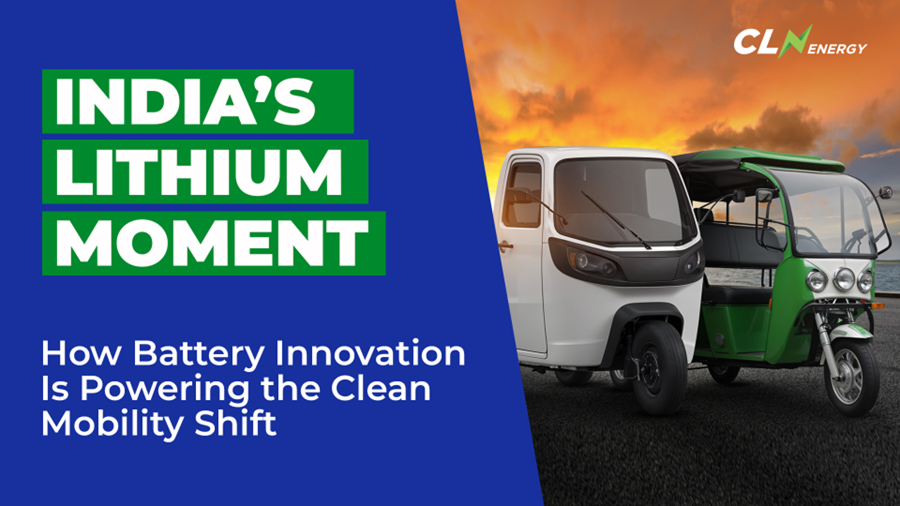
India's move to electric vehicles is not led by cars. It is led by the vehicles that work all day: e-rickshaws, e-autos, cargo three-wheelers, delivery scooters, forklifts in warehouses. For every one of them the battery is the single most important part — the largest cost, the thing that decides the range, and the component that either survives an Indian summer or does not.
This article covers what Indian electric vehicles ask of a lithium battery, where policy stands now, what still holds adoption back, and what to check before choosing a pack.
Lead-acid batteries powered the first wave of e-rickshaws because they were cheap to buy. They are heavy, lose capacity when discharged hard, sag in voltage as they empty and need replacing often. Lithium batteries fixed each of those, and for commercial vehicles in Indian conditions one lithium chemistry in particular has become the default: lithium iron phosphate, LiFePO4.
| What commercial EV duty needs | Why LiFePO4 suits it |
|---|---|
| Daily deep discharge | Thousands of cycles at a high depth of discharge |
| Heat — parked in the sun, run in summer | Better heat tolerance and a higher thermal runaway threshold than nickel-based lithium |
| Steady pulling power | Voltage holds through the discharge instead of sagging |
| Fast turnaround between shifts | Takes charge quickly and can top up in the gaps in a working day |
| No time for maintenance | Sealed, no water, protected by a battery management system |
The trade-off is energy density: LiFePO4 is heavier and larger than nickel-based chemistries for the same energy. That matters most in cars and premium scooters, and least under the floor of a three-wheeler or in the counterweight of a forklift.
Indian EVs are grouped by vehicle category, and the battery follows the vehicle. This is the range we build for them at our Noida plant:
| Vehicle | Category | CLN packs | Warranty |
|---|---|---|---|
| Two-wheeler | L2 | 57.6V 48Ah | 36 months |
| E-rickshaw | L3 | 51.2V at 105, 125, 140 and 150Ah; 60.8V 105Ah; 64V 105 and 140Ah | 36 months |
| E-auto | L5 | 51.2V and 60.8V at 200Ah | 36 months |
| Golf cart | — | 51.2V and 60.8V at 105Ah | 36 months |
| Forklifts and material handling | — | 25.6V 200Ah; 48V 400Ah; 80V 300 and 400Ah | 60 months |
Under ICAT test conditions with a 1 kW motor, our L3 packs deliver 100+ km on a full charge, which takes about four hours on a 25A charger. The L3 and L5 packs are IP67 rated, sealed against dust and monsoon water, with app monitoring available. The e-rickshaw range in detail is on the e-rickshaw lithium battery page, and the e-auto packs on the L5 battery page.
A lithium battery charged on the wrong profile either never reaches full charge or is stressed every night. The charger has to be matched to the pack's chemistry, voltage and current, and for vehicles charged outdoors it has to survive the weather too.
| Charger | Maximum power | Charging voltage and current | Protection | Warranty |
|---|---|---|---|---|
| IP67 1200 W | 1,200 W | 56 V, 20 A | IP67 | 3 years |
| IP67 1500 W | 1,500 W | 70 V, 25 A | IP67 | 3 years |
| IP67 3300 W | 3,300 W | 70 V, 50 A | IP67 | 3 years |
| IP20 1200 W | 1,200 W | 56 V, 21 A | IP20, indoor | 2 years |
| IP20 1800 W | 1,800 W | 70 V, 25 A | IP20, indoor | 2 years |
Much of what was written about EV incentives in 2023 is out of date. The FAME II scheme ended in March 2024, and the interim Electric Mobility Promotion Scheme ran for part of 2024. Both were replaced by PM E-DRIVE, which supports electric two-wheelers, three-wheelers including e-rickshaws and e-carts, buses, trucks and charging infrastructure. The scheme is fund-limited and runs to March 2028, with different end dates and caps by vehicle category — the two-wheeler incentive, for example, ended in July 2026. Check the current terms for your vehicle on the official PM E-DRIVE portal rather than relying on a figure from an older article.
On the manufacturing side, production-linked incentive schemes support advanced chemistry cells and automotive components, aimed at bringing more of the battery supply chain into India.
Four things: cells are still largely imported, charging is uneven for anyone without a depot, financing is harder than for a petrol or diesel vehicle, and pack quality varies enormously between products that look identical from the outside.
Match the voltage to the vehicle’s motor and controller, size the capacity to the daily running rather than the brochure’s range figure, and ask for test reports covering the pack itself. The full list:
For fleet owners comparing the switch in money terms, LiFePO4 or lead-acid for an e-rickshaw fleet works through the arithmetic on your own numbers.
Both lead-acid and lithium are still in use, but new e-rickshaws and conversions are moving to lithium iron phosphate (LiFePO4) because it lasts many more cycles under daily deep discharge, tolerates heat better, needs no maintenance and holds its voltage as it empties. CLN's L3 e-rickshaw packs run at 51.2V, 60.8V or 64V from 105Ah to 150Ah.
Electric three-wheelers, including e-rickshaws and e-carts, are covered by the PM E-DRIVE scheme, which runs to March 2028 but is fund-limited and has caps by vehicle category. Terms change, so check the current incentive on the official PM E-DRIVE portal before relying on it.
L3 and L5 are Indian vehicle categories, not battery sizes. L3 covers e-rickshaws and L5 covers e-autos and heavier three-wheelers, so L5 packs are larger: CLN's L5 packs are 200Ah at 51.2V or 60.8V, while its L3 packs run from 105Ah to 150Ah.
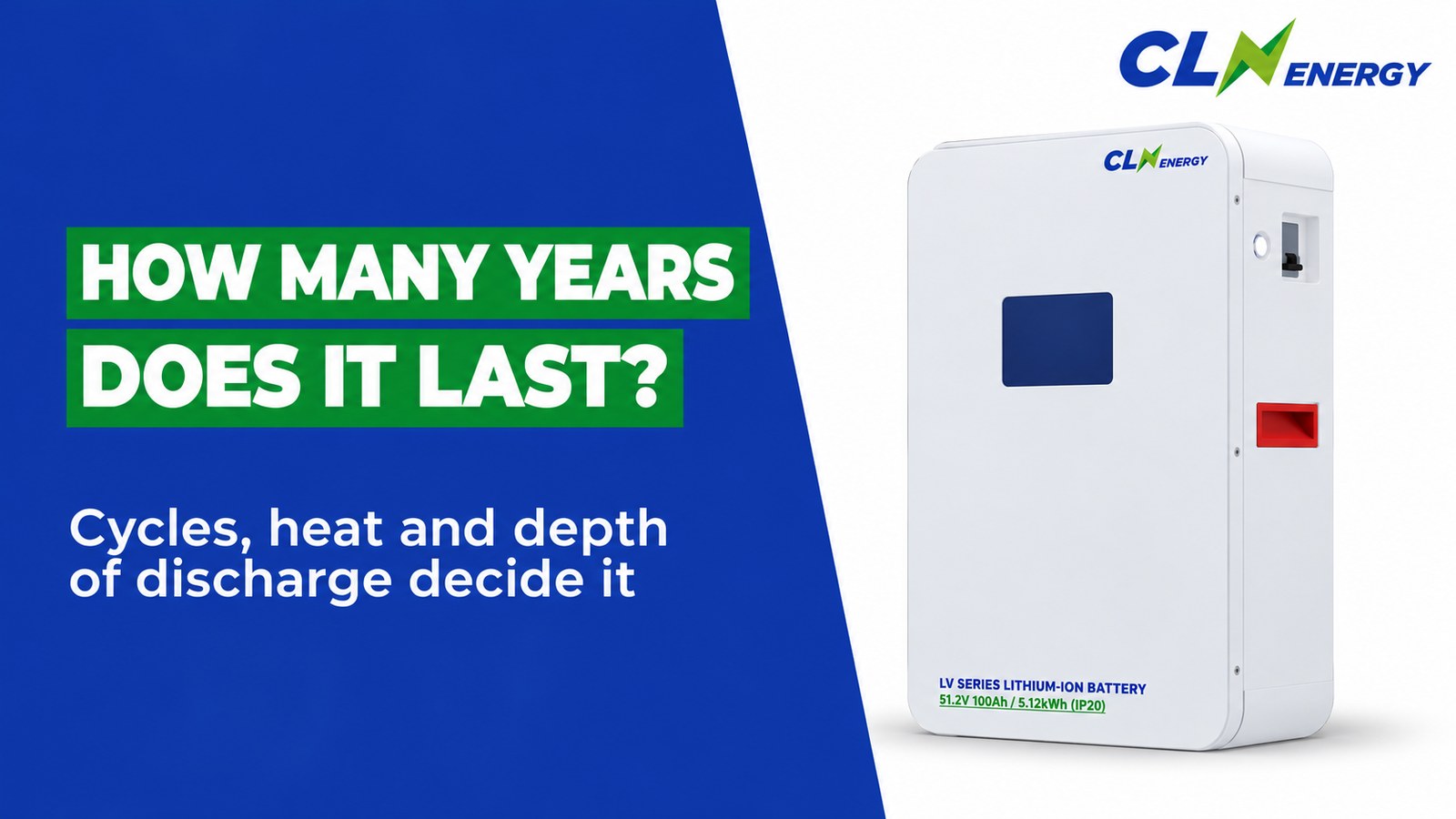
It is rated in charge cycles at a stated depth of discharge, and the years that become depend on how hard the vehicle works. CLN's L3 packs carry a 36-month warranty, and the cycle figure worth asking for is the one with its depth of discharge and temperature attached. A commercial vehicle charged daily uses cycles far faster than a private one.
Because commercial duty in India combines daily deep discharge with heat. LiFePO4 lasts thousands of cycles at a high depth of discharge, has a higher thermal runaway threshold than nickel-based chemistries and holds its voltage under load. Its lower energy density matters little in a three-wheeler or a forklift.
Yes. The charger must match the pack's chemistry, voltage and current, or the battery will either stop short of a full charge or be stressed every night. For vehicles charged outdoors, an IP67 charger is worth the difference; CLN's range runs from 1,200 W to 3,300 W.
Standards and government figures link to the organisation that publishes them. Figures about CLN products and deployments come from our own specification tables and project records, linked here so they can be checked.

 Become a
Partner
Become a
Partner


Comments: