
By CLN Energy Limited BSE SME listed, scrip 544347 Lithium battery manufacturer, Noida Published Updated
A UPS battery is bought to do one of two quite different jobs, and the specification that suits one is wrong for the other. Either it carries the load for a few minutes while a generator starts, or it carries the load for half an hour or more because there is no generator, or because the generator sometimes does not start. Deciding which of those you are buying is the first question, and it changes almost everything after it.
A five-minute battery works harder than a thirty-minute one carrying the same load. It sounds backwards, but the short-autonomy battery is under more strain. Five minutes of backup at full load means delivering the pack's entire energy in a twelfth of an hour — a very high discharge rate. Thirty minutes at the same load draws the same energy far more gently.
That rate is what the C-rate describes, and it is why our data-centre range is two series rather than one:
| Specification | 5–15 minute series | 30–60 minute series |
|---|---|---|
| Models | CLN24050U, CLN48050U | CLN240100U, CLN384100U, CLN480100U |
| Nominal voltage | 240 and 480 Vdc | 240, 384 and 480 Vdc |
| Energy | 12 and 24 kWh (50Ah) | 24, 38.4 and 48 kWh (100Ah) |
| Standard discharge | 50 A (1C) | 50 A (0.5C) |
| Maximum discharge | 300 A (6C) | 200 A (2C) |
| Charging, standard / maximum | 25 A / 50 A | 25 A / 50 A |
| Cycle life | 3,000 at 80% DOD, 0.5C/0.5C | |
| Cabinet (W × D × H) | 600 × 800 × 1,400 or 2,000 mm | 600 × 800 × 1,400 or 2,000 mm |
| Weight | About 290 and 430 kg | About 310, 490 and 590 kg |
| Operating temperature | 15–45°C, recommended 20–25°C | |
| Communication | CAN, RS485, dry contact | |
| Certifications | UL1642, UN38.3, IEC62619, IEC62133 | |
A system sized only on kilowatt-hours can be perfectly adequate on paper and still be the wrong buy, because it cannot deliver them fast enough. Ask for the rated and peak discharge current, and check both against the load you actually have to hold.
Get the DC bus voltage and its charging voltage window from the UPS manual before anything else is discussed. This is the constraint people meet last and should meet first. A UPS runs a fixed DC bus, and the battery must be built for it — ours come at 240, 384 and 480 Vdc nominal, made up of 48V modules in series (1P15S per module, then 75, 125 or 150 cells in series across the pack). A battery that cannot sit on your bus is not a cheaper option, it is not an option.
Four things, in the order the facilities team will notice them:
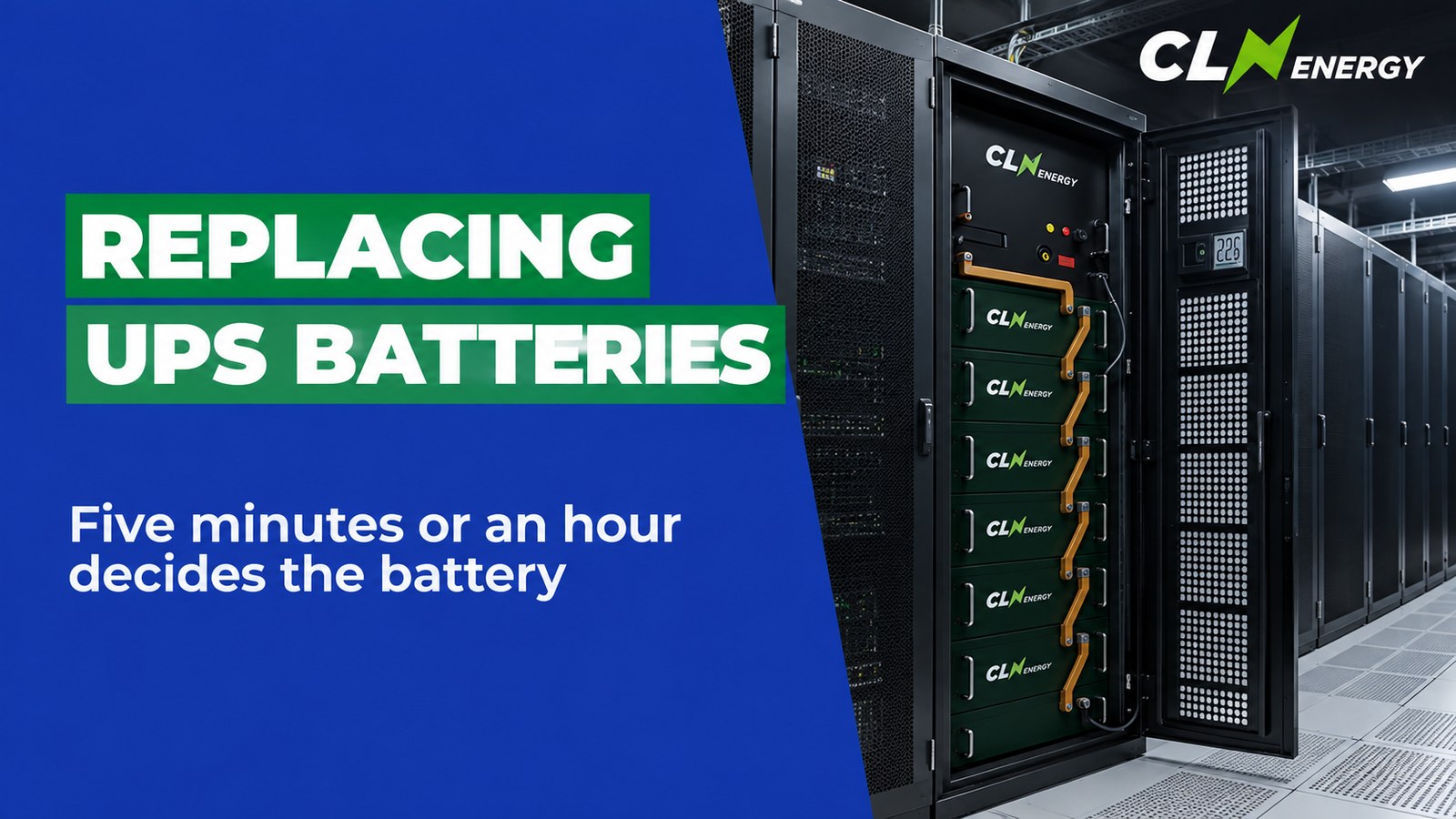
CLN data-centre packs carry UL1642, UN38.3, IEC62619 and IEC62133. This is the section to read twice, because the battery is going into a room full of things you cannot afford to lose. Ask for the certificates covering the exact model you are buying rather than a company-level statement, and ask what fire detection and suppression the room already has and whether the supplier's installation assumes more. What each standard actually covers takes ten minutes to read and saves an argument later.
A UPS battery replacement and a full storage system are different projects with different economics. If what you are weighing is the wider case — peak shaving, running the hall through a longer outage, or cutting generator hours — replacing a UPS battery with lithium and the payback period for commercial storage put numbers against both.
The question that decides whether a replacement happens this year or next is what happens to the load during it. It can be done inside a maintenance window: at RailTel's command control centre in Pondicherry we put 180 kWh behind a 100 kW UPS, and the changeover was completed in a two-hour window with the centre never off supply. What that takes is planning the bypass, the DC isolation and the sequence in advance, and having someone on site who has done it before.
At that capacity the bank covers far more than a generator handover needs, which is the other reason to think about autonomy deliberately: a generator that fails to start becomes an inconvenience rather than an outage.
Decide the minutes first. Get the DC bus voltage from the UPS manual. Ask for discharge current as well as kilowatt-hours. Check the floor loading and the room temperature. Ask what the battery reports and to what. Then compare suppliers on those answers rather than on the headline capacity.
The full range, with the specification table for each model, is under data centre batteries. For commercial and industrial storage more broadly — containerised systems, generator replacement, peak shaving — our energy storage site covers UPS replacement in more depth.
Usually yes, provided the battery is built for the UPS's DC bus voltage and the UPS can charge a lithium profile. Take the bus voltage and the charging voltage window from the UPS manual first, then match the battery to it. Where the UPS cannot be set for lithium, that is a conversation about the UPS, not the battery.
It depends on what comes after it. Where a generator starts automatically, five to fifteen minutes is the usual design and the battery must be rated for a high discharge rate to deliver it. Where there is no generator, or where one has failed to start before, thirty to sixty minutes is the normal specification and the battery is sized for energy instead.
For most data centres, yes, on the grounds that matter there: a lithium iron phosphate bank takes less floor space for the same backup, tolerates more cycling, and reports its state over CAN or RS485 instead of revealing its condition only in a load test. VRLA remains cheaper to buy. The decision rests on how long you will keep the UPS, how often the batteries are tested and replaced, and what floor space costs you.
C-rate is how fast a battery is charged or discharged relative to its capacity: 1C empties it in an hour, 2C in half an hour, 6C in ten minutes. A short-autonomy UPS battery must be rated for a high discharge rate, which is why our 5 to 15 minute series is rated to 300 A (6C) while the 30 to 60 minute series is rated to 200 A (2C). Two systems with the same kilowatt-hours are not interchangeable.
Our data-centre cabinets are 600 × 800 mm on the floor and 1,400 or 2,000 mm tall, weighing 290 to 590 kg depending on the model. In a raised-floor room the weight is the constraint worth checking first, since it concentrates on a small footprint rather than spreading along a battery rack.
Standards and government figures link to the organisation that publishes them. Figures about CLN products and deployments come from our own specification tables and project records, linked here so they can be checked. CLN Energy is one of the lithium ion battery manufacturers in India that assembles and tests its own packs, at its Noida plant.
Looking for the batteries themselves? Data centre UPS batteries →
Our energy storage website sets out lithium battery storage for a commercial site.

 Become a
Partner
Become a
Partner


Comments: